Product Manager (Side Project) · 2025 - Present · Solo with Claude and ChatGPT as engineers
Visit Website

RoleRadar

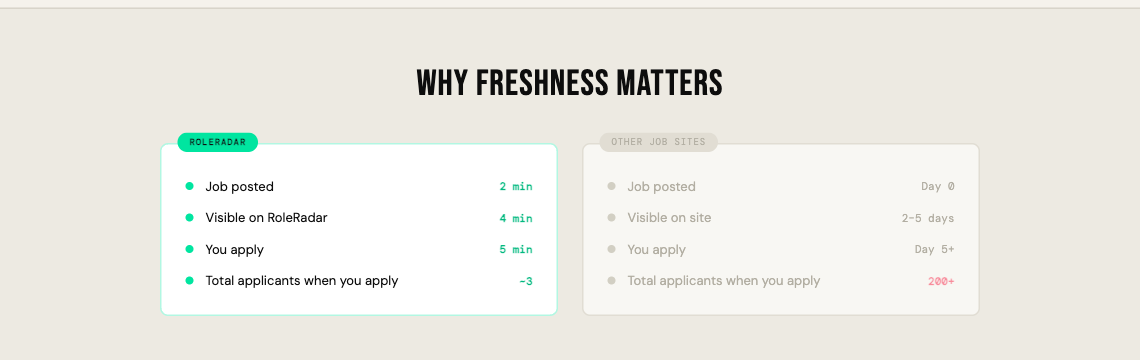
Built for speed and freshness - no stale jobs, ever. Real-time alerts ensure users apply first, not last
4,297+
Page Views
4,272+
Search queries
3,161+
Job applications initiated
727+
Unique companies applied to

The Job Seeker Pain Point

Job seekers waste valuable time on repetitive, manual searches across platforms

Time Wasted on Manual Searches
Job seekers spend 20+ hours weekly checking multiple sites
Opportunity Cost: Time that could be spent on networking, interview prep, or skill development
Missing the Application Window
Popular jobs close quickly, often within hours of posting
Late applicants face significantly lower response rates
Fragmented & Incomplete Market View
Existing aggregators miss specialized roles (ML, RevOps, AI Engineer)
Job seekers miss opportunities that match their unique skillsets

Loading metrics...

The Strategic Bet

Conventional wisdom

Build a better job board with cleaner UX and modern design.

Data showed

User interviews revealed the real problem wasn't the interface - it was the data. Job seekers checked multiple sites daily because no single source was comprehensive or fresh enough.

The decision

Instead of competing on UX, compete on data quality and freshness. Build a data-first product that serves multiple user segments.

Product Trade-offs & Prioritization

Constraints and decisions that shaped product

Operating Constraints

Bootstrap budget requiring creative resource allocation
Competing against well-established incumbents
Establish trust with users burned by outdated job data

API-first approach before building consumer UI

Instead of: Build a polished consumer app first to attract end users

Why I chose this

GenAI (Claude and ChatGPT) could provide faster, more actionable feedback. Consumer UX would require more iterations to get right.

Consequence

Slower initial user acquisition, but early users validated product-market fit and provided feedback.

Expand

Focus on freshness over coverage initially

Instead of: Maximize company coverage before optimizing for speed

Why I chose this

User research showed freshness was the #1 pain point. A smaller set of always-fresh listings beat a large set of stale ones.

Consequence

Users trusted data more, leading to MVP success. Added features gradually as trust was established.

Expand

Email alerts as MVP for non-technical users

Instead of: Build a full web application with search and filtering

Why I chose this

Email alerts solved the core problem (fresh jobs delivered to you) with minimal development. Validated demand before major UI revamp.

Consequence

Email alerts became most-liked feature. Web UI was built later with user feedback already in hand.

Expand

Product Architecture Decisions

Key technical choices and the reasoning behind them

Build data platform first, interfaces second

vs. Full-stack productvs. Mobile appvs. Browser extension
Reasoning

A strong data foundation enables multiple distribution channels. Users can consume via API, email, web, or future channels. Flexibility to pivot based on market feedback.

Trade-offs

Requires upfront time investment to design infrastructure. But creates optionality that a single-channel product doesn't have.

Expand

Prioritize US market with multi-state support

vs. Single metro focusvs. Global launchvs. Remote-only jobs
Reasoning

US market is large enough to validate the model. State-by-state coverage matches how job seekers actually search.

Trade-offs

Limited international reach initially. But allowed to go deep on quality in a defined market.

Expand

Segment by application type (Quick Apply vs. Detailed)

vs. No segmentationvs. Segment by industryvs. Segment by company size
Reasoning

User research showed application complexity affects job seeker behavior. Quick Apply jobs get more volume; detailed applications attract more serious candidates.

Trade-offs

Added complexity to filtering. But gave users control they valued highly.

Expand

Free tier with premium alerts

vs. Freemium with limited searchesvs. Subscription onlyvs. Ad-supported
Reasoning

Job seekers are price-sensitive during unemployment. Free access builds trust and user base.

Trade-offs

No initial revenue. But better word-of-mouth growth.

Expand

User Discovery & Validation

Aligning stakeholders with competing priorities

Job Seekers

Overwhelmed by existing options

Their concern

"I've tried everything. They all show the same outdated jobs. Why is this different?"

How I aligned them

Built transparent live dashboard showing real platform metrics. Users can see actual job counts and data freshness.

Outcome

Platform provides comprehensive coverage across 3,700+ companies that users can verify themselves.

Product/PM Job Seekers

Frustrated by lack of specialized role coverage

Their concern

"Established Job Boards don't surface the roles I'm looking for."

How I aligned them

Integrated with public pages that companies use, capturing roles before they hit major boards.

Outcome

Product captures specialized roles from companies that primarily hire through their ATS.

Remote Job Seekers

Difficulty filtering for true remote positions

Their concern

"I waste time on jobs that say remote but are actually hybrid or specific locations."

How I aligned them

Built remote job filtering with location parsing to distinguish true remote from hybrid positions.

Outcome

Users can filter by remote-friendly positions across all integrated companies.

User-Centric Product Strategy

Aggregated jobs from 3,700+ company career pages, delivering opportunities to users before they appear on major boards. The platform handles the monitoring so job seekers can focus on applying.

1

Real-Time Job Alerts

Delivered new job notifications via email, giving users the early applicant advantage.

Result
Email alerts enable users to apply to new postings before they appear on major job boards.
2

Comprehensive Coverage Strategy

Aggregated jobs from 3,700+ company career pages across multiple ATS platforms.

Result
Users find specialized roles (PM, ML, DevRel) before they vanish.
3

Multi-State Coverage

Built location filtering across 38+ US states for targeted job searches.

Result
Users can focus on opportunities in their target geographic areas.
4

Trust Through Transparency

Built user trust by showing real-time platform metrics openly.

Result
Users can verify the platform is actively maintained with current data.

Before → After

Quantified impact of the transformation

Company Coverage
Before
0
After
3,700+
Companies actively monitored
Active Job Listings
Before
0
After
159K+
Jobs available to search
Geographic Coverage
Before
0
After
38+
US states with job data
Data Freshness
Before
Days old
After
Updates every 2-3 hours
Always current job data

When Things Went Wrong

A failure that taught me more than success

The situation

Month 3: Data quality dropped significantly for major employers. Users reported seeing outdated jobs.

What went wrong

Prioritized coverage expansion over monitoring. Didn't have alerting for data freshness issues until users complained.

Impact

Lost 3 early adopter users permanently. Trust is hard to rebuild once broken.

How I recovered

Implemented proactive quality monitoring with automatic alerts when freshness drops. Added user-facing "data health" indicator so users could see quality status. Reached out personally to churned users with improvement roadmap.

The lesson

Product quality is a feature. Users will forgive missing features, but not broken promises. Build monitoring before you need it.

Process Innovation

Building scalable systems from the ground up

Scalable Design

Problem

Adding new company coverage was slow, limiting ability to respond to user requests

Innovation

Created a standardized architecture to identify companies actively hiring

Adoption

User-driven prioritization meant focus on companies that mattered most to users, not arbitrary lists.

Impact

Grew from 100 to 2,500+ companies in 4 months. User satisfaction increased as they saw their requests implemented.

Lessons Learned

Reflection on what could have been done differently

Delayed user research in favor of building

Impact: Built features users didn't prioritize (advanced filters) before features they needed (email alerts)

Better approach

Continuous user interviews from day 1, even with a small user base

Would have shipped email alerts 6 weeks earlier

Perfectionism on launch

Impact: Delayed public launch waiting for "complete" coverage

Better approach

Launch with top 100 companies, validate, then expand

Would have gotten market feedback 4 months earlier

Business Impact

Data-driven product decisions

Every product decision is informed by real user behavior data. The live analytics dashboard shows actual user interactions, helping prioritize features based on what users actually do - not what they say they want. This data-driven approach led to removing the 6-hour filter (low value despite usage), prioritizing location-based search (high engagement), and focusing on application flow optimization.

Key Takeaways

1

Compete on what matters most to users. For job seekers, it was data freshness, not UI polish.

2

Trust is earned through transparency. Showing data quality metrics increased user confidence.

3

User requests are gold. Best features came from listening to early adopter feedback.

Get in Touch

Let's talk about
what you're building.

Interested in how I can help your team ship faster? I'd love to hear what you're working on.